Real estate fund model and pitch deck, built from the same numbers
Smart Deck builds real estate fund models and pitch decks for sponsors raising from LPs and lenders. You get the fund or project model, the waterfall, and the deck investors read, on one private link.
For first-time and emerging fund managers, developers, private credit and project sponsors. From $4,000.

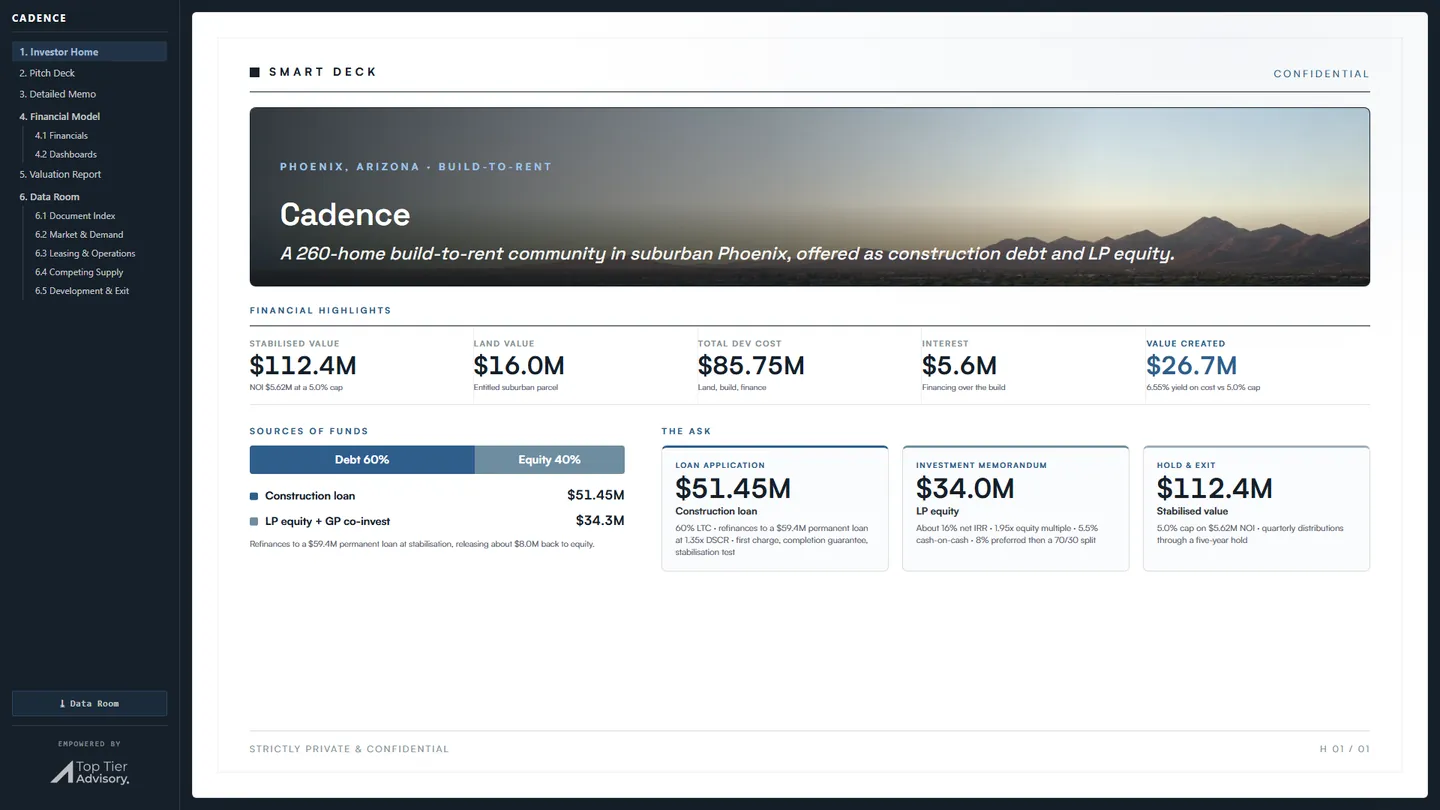
What you get
What you get
The model comes first. The deck, the teaser and the data room read their numbers from it.
The fund or project model
The distribution waterfall
The LP or lender pitch deck
The teaser and a data room
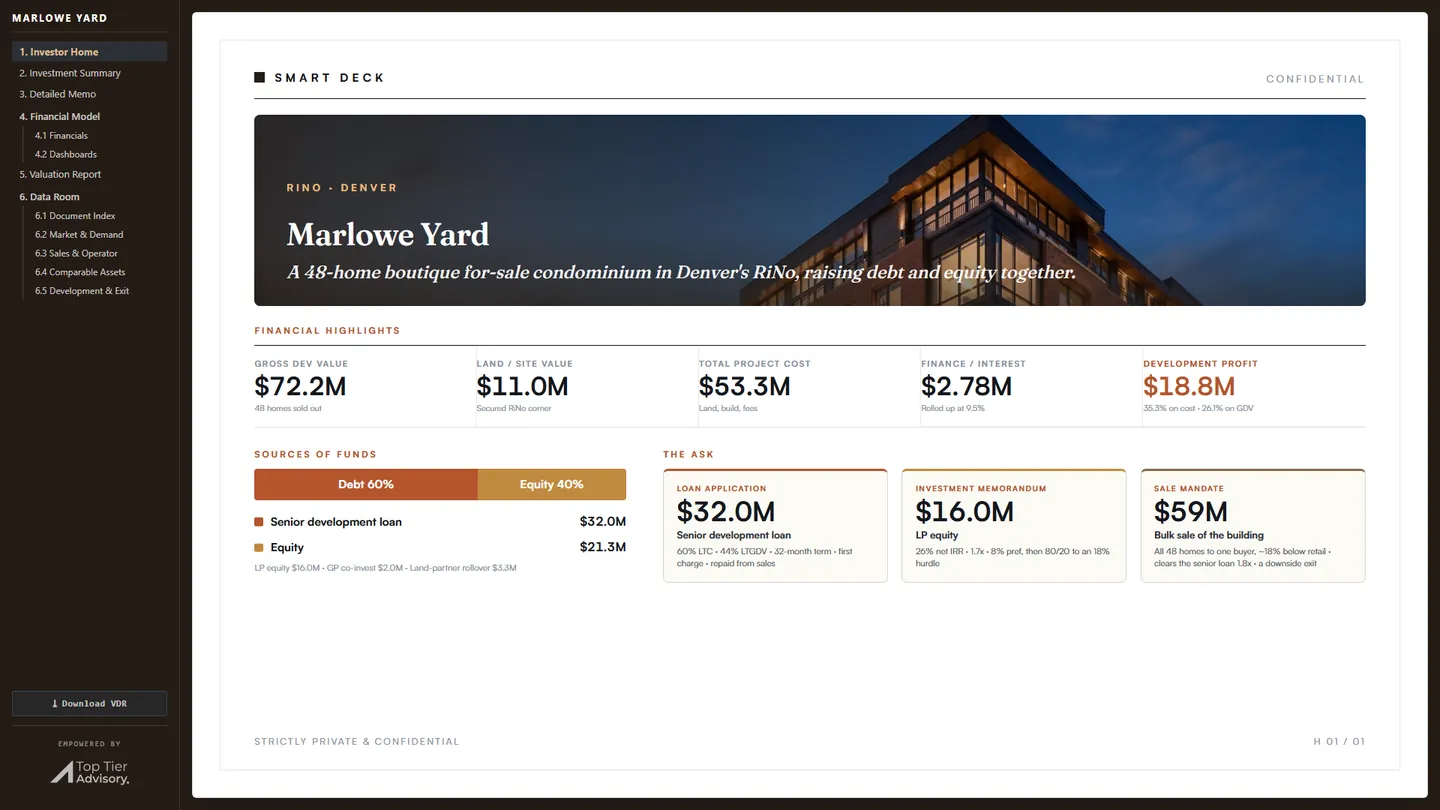
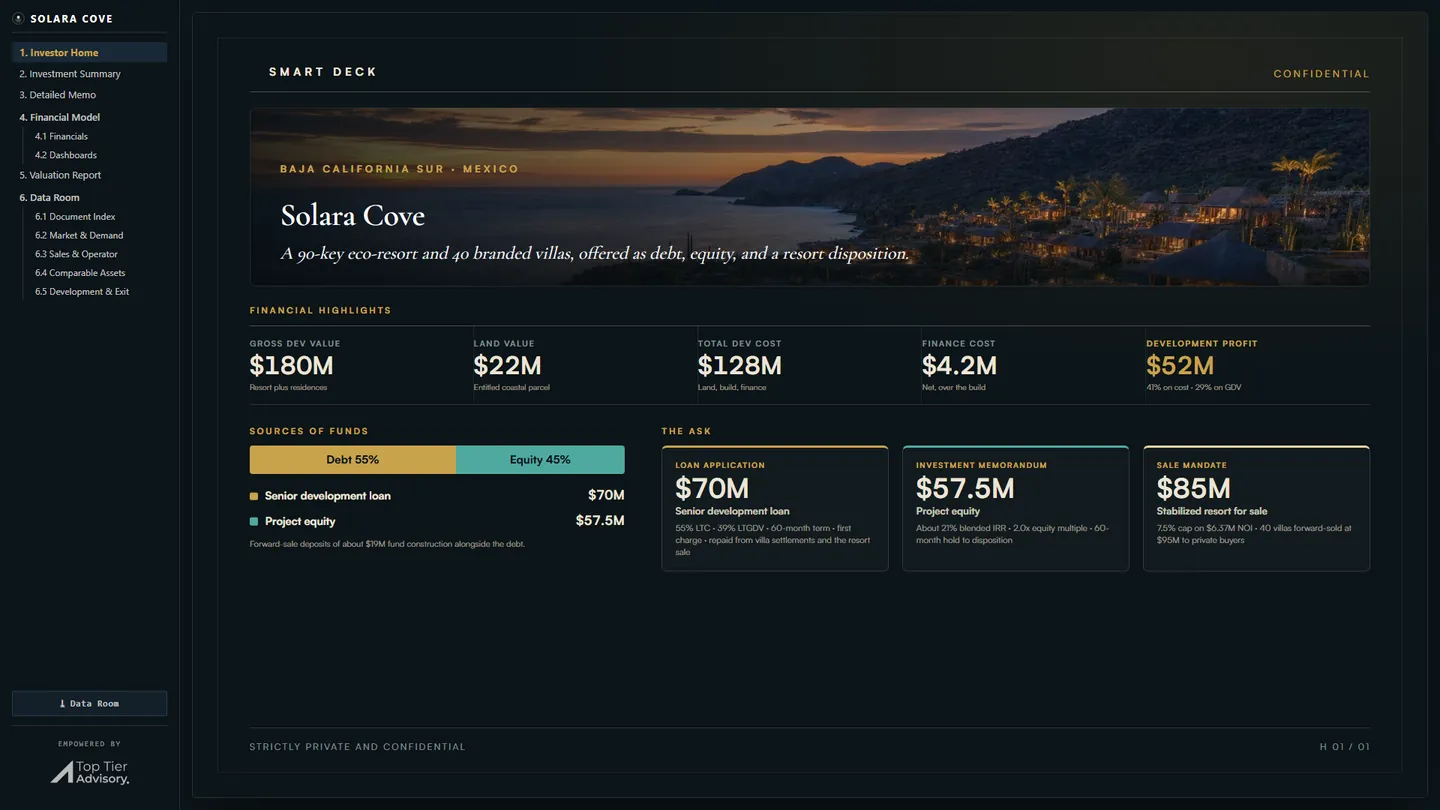
Sample Smart Decks for made-up companies. See the property samples →
Which model
Which real estate financial model you need
Who reads the model decides what goes in it. LPs read for returns, lenders read for cover.
| Model | Who reads it | What they check first | What goes in the model |
|---|---|---|---|
| Real estate fund | LPs | Net IRR and equity multiple | Capital calls, deployment by asset, fees, exits and the distribution waterfall |
| Single development project | Equity investors and a lender | Profit on cost and GDV | Development appraisal, build costs and timing, sales or lettings, and the debt |
| Private credit fund | LPs | Deployment against capital raised, and losses | The loan book, interest income, defaults and recoveries, fees and the waterfall |
| Project finance | Lenders | DSCR | Construction and operating cash flows, debt sizing, sources and uses, and the debt schedule |
Before legal
The waterfall, checked before legal
Your fund lawyer drafts the limited partnership agreement. The waterfall in the model has to match it, line for line. If it doesn't, the returns in the LP deck are wrong, and an LP who reads both will find it. We check the model against the terms before the deck is written, so the deck never repeats a number the agreement won't pay.
What we check:
- The hurdle: the preferred return rate, and whether it compounds.
- The catch-up: how much goes to the GP, and when it stops.
- Tax: where it sits in the cash flow before anything is distributed.
- Interest on shareholder or sponsor loans, and whether it's paid before the waterfall starts.
We model the terms you've agreed. We don't advise on how to structure the fund. That's your fund lawyer's job. Read our real estate fund model case study for the checks in more detail.
Worked example
Worked example: one $20M fund, LP returns by tier
A made-up fund, for illustration only. $20M of LP commitments, an 8% preferred return a year (not compounded) over five years, a 100% GP catch-up and an 80/20 split. It returns $36M in total.
| Tier | To LPs | To the GP | Left to distribute |
|---|---|---|---|
| 1. Return of capital | $20.0M | $0 | $16.0M |
| 2. Preferred return at 8% for five years | $8.0M | $0 | $8.0M |
| 3. GP catch-up at 100% | $0 | $2.0M | $6.0M |
| 4. 80/20 split | $4.8M | $1.2M | $0 |
LPs get $32.8M back on $20M, an equity multiple of 1.64x. The GP gets $3.2M, which is 20% of the $16M profit, so the catch-up did its job.
Lenders
Project finance models and lender decks
A lender reads a project differently from an LP. The lender's question is whether the project's cash flow covers the debt, every period, with room to spare. So the model and the deck lead with cover, and the deck answers the lender's questions in the order they ask them.
- DSCR: cash available for debt service against what's due, period by period.
- Debt sizing: how much the project can borrow at the cover the lender wants.
- Sources and uses: where the money comes from and where it goes.
- The downside: what happens to cover if costs run over or income comes in late.
See our project finance model review case study and our private credit fund model case study.
Existing model
Already have a model?
Send it to us. We check the links, the hard-coded numbers, the scenarios and the waterfall, and tell you what to fix. If it mostly works, we fix it and write the deck from it. If it doesn't, we rebuild it. Start with a financial model review.
Raising a fund
What LPs ask to see
The materials side of raising a fund. We build the materials, we don't introduce investors.
- A track record table: past deals, what went in, what came out, and the returns.
- The strategy: what you buy or build, where, and why you're the one to do it.
- The pipeline: the first assets or the deals under offer.
- A terms summary: fund size, fees, the hurdle and the carry.
- The model, so an LP can test the returns for themselves.
Price
Price and timing
From $4,000, up to about $10,000 by scope. We quote after the first call, before any work starts. What moves the price:
- How complex the waterfall is.
- How many layers of debt there are.
- How many assets the model covers.
- How many versions you need, for example one deck for LPs and another for a lender.
Samples
Sample work
Raising for sponsors as a firm? See white-label work.
Top Rated Plus on Upwork, with $600K+ earned across 317 jobs.
Questions
Questions sponsors ask
What should a real estate fund pitch deck include?
The strategy, the team's track record, the pipeline or first assets, the fund terms in summary, and the returns the model shows for LPs. Every return figure on the slides should come from the model, so an LP who opens the spreadsheet finds the same number.
How do you model a distribution waterfall with a catch-up?
Tier by tier. LPs get their capital back, then the preferred return. The catch-up then sends cash to the GP until the GP holds its agreed share of the profit so far, and the rest splits on the carry terms, for example 80/20. We build it so you can change the hurdle, the catch-up and the split and see LP and GP returns move.
Can you build an LP deck from my existing fund model?
Yes. We check the model first, because the deck will repeat whatever it says. Then we write the deck from it, so the slide numbers match the model.
How much does a real estate fund financial model cost?
From $4,000, up to about $10,000 with the pitch deck, teaser and data room. The waterfall, the debt layers and the number of assets move the price. The pricing page shows what changes it.
More
Other ways we work
Ready when you are
Get your fund model and deck built.
Start with a call about the fund, the terms and who you're raising from.